
Search
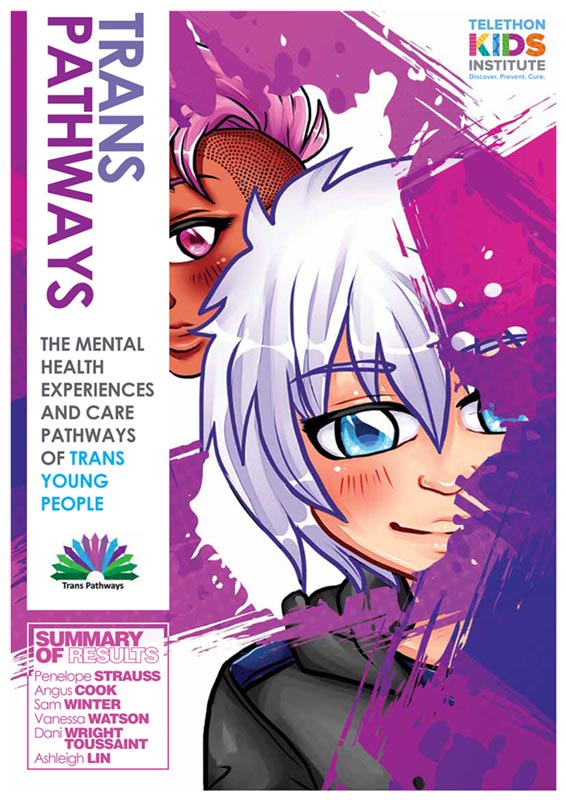
Trans Pathways is the largest ever survey conducted into the mental health of trans young people in Australia.

We have launched a national survey to investigate how we can better support young people who don't identify as the gender they were assigned at birth.

A remarkable Institute leader will join a cohort of 25 STEM-qualified women to take part in the prestigious 2024 Women in Leadership Development (WILD) program.
We want to better understand the relationship between parents/carers and their children who identify as trans or gender diverse with the aim of improving the well-being of the whole family.
SPARX is a form of computerized cognitive behavioural therapy in serious game format funded via the Ministry of Health to be freely available in New Zealand. At registration users identify themselves as male, female, transgender or intersex. We aimed to establish whether adolescent transgender users of SPARX, compared to adolescent male and female users, were more likely to have high mental health needs at baseline and were more likely to complete SPARX. We also sought to determine changes in transgender adolescents' depressive symptoms after using SPARX.
The health and well-being of transgender, non-binary, and gender-diverse people is receiving increasing attention from epidemiologists and public health researchers, including those utilizing longitudinal observational cohort studies.
Population-level, nationally representative data on the prevalence of minority stressors and traumatic events, mental ill-health effects, and the preventative utility of school climate, among gender and sexuality diverse young people in Australia, is significantly lacking.
The formation of online communities instils a sense of connectedness which can ameliorate the mental health concerns that result from minority stressors for lesbian, gay, queer, intersex, asexual, and other diverse genders/sexualities (LGBTQIA+). The aim of this study was to explore how LGBTQIA + people communicate social and mental health concerns on TikTok.
Nonsuicidal self-injury (NSSI) is particularly common among trans young people. Trans young people tend to experience high levels of emotional distress due to the unique stressors they face, and often use NSSI as an emotion regulation strategy. These stressors include gender dysphoria, body image concerns, and transphobic experiences.
Young people who are lesbian, gay, bisexual, trans, queer or questioning, asexual and other diverse genders and sexualities (LGBTQA+) are at greater risk of adverse mental health outcomes and suicide, with additional barriers to accessing safe and affirming physical and mental health services in comparison to the general population.